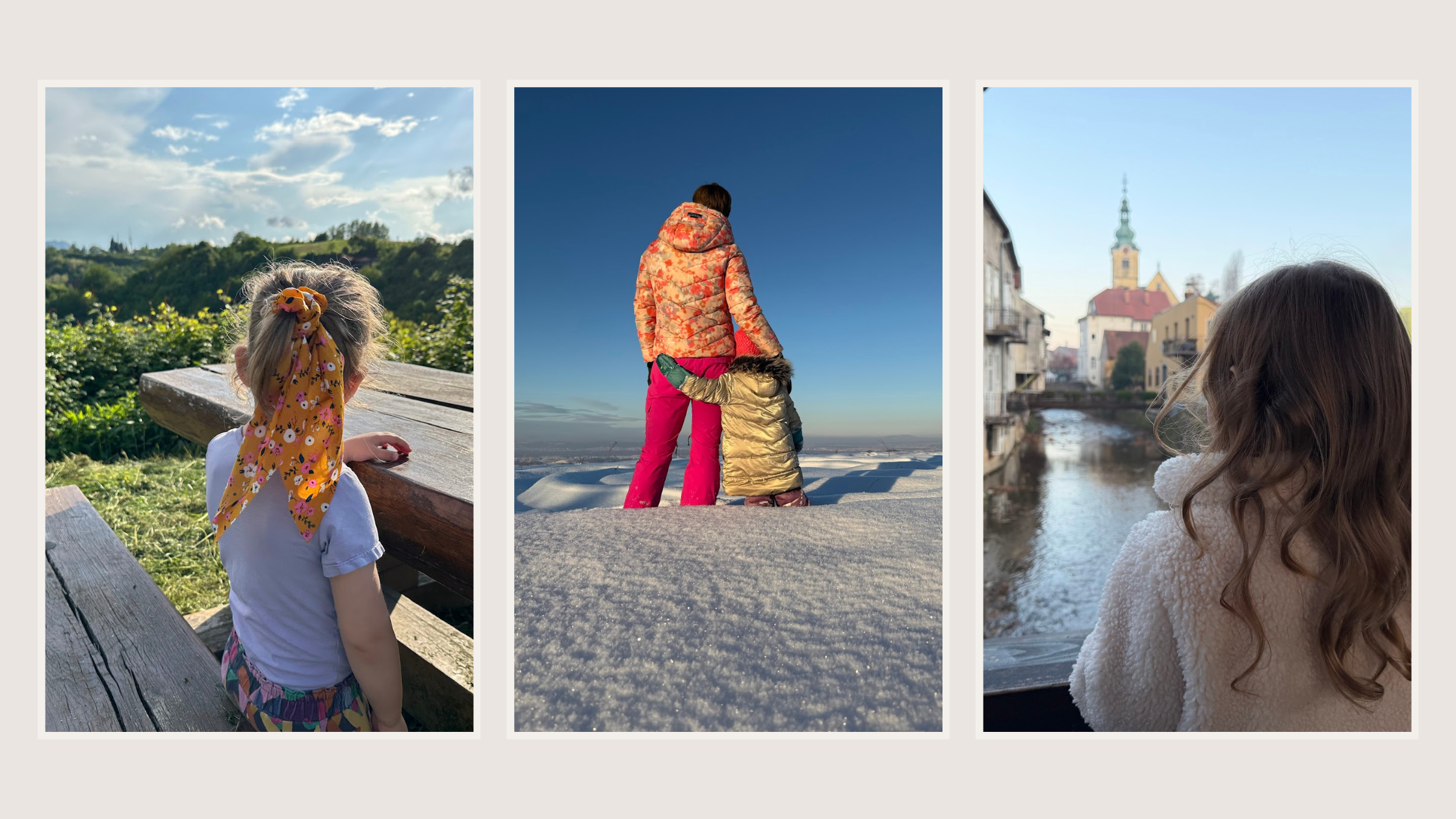
by Erika Matic, allegedly “through the hardest part” and somehow still standing
There is a phrase that follows new mothers like a haunted doll with impeccable timing.
“You’ll miss this.”
It appears when you are exhausted.
It appears when you are crying.
It appears when you haven’t slept longer than 47 consecutive minutes and your body no longer belongs to you, but to a small, loud creature with opinions about nipples.
“You’ll miss this,” people say gently, lovingly, confidently – usually while holding a coffee, having slept, and not being responsible for the human currently screaming in your arms.
They say it about the newborn stage.
They say it about the baby stage.
They say it about the part where you are technically alive but spiritually unavailable.
And I believed them. At first.
Because everyone says it gets harder as children grow older. More complicated. More demanding. More emotional.
But here is my deeply inconvenient truth: For me, the beginning was the hardest part.
Motherhood Did Not Gently Introduce Itself
I did not ease into motherhood.
Motherhood kicked the door down, stole my sleep, rearranged my hormones, and handed me a tiny person who needed me for absolutely everything (including the ability to exist).
I didn’t sleep.
I didn’t rest.
I didn’t recognise myself.
I breastfed exclusively, which sounds poetic until you realise it means your body is no longer your own. You are the restaurant. The comfort object. The survival system.
There were days I cried sitting on the toilet, quietly, because my daughter was teething at three months old and no one prepares you for how loud pain can be in such a small body.
There were nights when time stopped making sense.
And through it all, the chorus continued:
- “Just wait until she starts crawling.”
- “Just wait until she walks.”
- “Just wait until she talks.”
Each milestone presented itself as a threat.
A warning.
A promise that whatever you’re struggling with now is nothing compared to what’s coming.
I waited. And then… something unexpected happened.
It Got Easier. Not Perfect. Easier.
As my daughter grew, she didn’t become harder – she became more human.
She could tell me what hurt.
She could show me what she needed.
She could walk beside me instead of only clinging to me like a koala with abandonment issues.
She ate on her own. Slept more. Communicated.
And slowly, quietly, I found myself again.
Not the woman I was before motherhood (she is gone and that’s fine), but a new version who could breathe, think, laugh, and exist without constant panic humming under her skin.
I started enjoying her.
Not just loving her (that part came immediately and violently) but enjoying her.
Playing. Going places. Watching her discover the world with curiosity instead of screams.
And no, it wasn’t suddenly easy. Toddlers are chaos in leggings. Tantrums are real. Patience is tested daily.
But here’s the thing no one told me: Hard doesn’t always mean worse. Sometimes it just means different.
The Madness of Modern Parenting
Raising a child today is not for the weak.
Everyone has an opinion.
Everyone is watching.
Everyone is convinced you’re doing it wrong.
Screens are everywhere. Advice is constant. Comparison is unavoidable.
My husband and I limit technology as best we can, which makes us either responsible parents or suspicious minimalists, depending on who you ask.
There is no neutral choice anymore. Every decision feels political. Ethical. Psychological. Potentially scarring.
And yet, through all of this noise, my daughter looks at me and says, “Mom, I love you.” And suddenly, everything quiets.
I am still afraid sometimes. Of the world. Of her future. Of getting it wrong. But my role is no longer just keeping her alive. My role is shaping a human.
Teaching kindness. Boundaries. Empathy. Strength. Softness.
And that feels… grounding.
The Only-Child Decision Nobody Asked For (But Everyone Has Thoughts About)
I knew early on that I was meant to have one child. Not because I don’t love motherhood, but because I know myself.
I know my limits. I know what I can give without disappearing. Four years later, I still stand by that decision. Peacefully. Confidently. Unapologetically.
And yes, people love to explain to me why I’m wrong.
- “She’ll be lonely.”
- “You’ll regret it.”
- “She needs a sibling.”
As if children are group projects. As if love is divisible. As if a mother who knows her capacity is somehow failing.
But my daughter is loved. Deeply. Intentionally. Fully.
And so am I.
That matters.
You’re Not Broken If You Didn’t Love the Beginning
Here is what I wish someone had told me when I was crying on bathroom floors and counting minutes between feedings:
- You are not broken if you don’t enjoy the newborn stage.
- You are not ungrateful if motherhood felt like grief before it felt like joy.
- You are not failing if you need time to grow into this role.
- And no – you are not obligated to miss something that almost broke you.
Some mothers bloom immediately.
Others take time.
Both are valid.
Both are mothers.
The Quiet Truth at the End of the Day
Now, my daughter is almost four. She is still small. Still needs me. Still reaches for my hand. But she is also becoming her own person – funny, stubborn, thoughtful, wild.
At night, after the tantrums and negotiations and deep philosophical debates about dinner, she looks at me with complete trust.
There are nights when I watch her sleep and feel something close to grief. Not because she is leaving, but because she is becoming.
Because every day, she moves one step further away from the version of her that fit entirely in my arms, and one step closer to a world that will not love her as carefully as I do.
No one warns you that motherhood contains loss from the very beginning. That even as you gain this overwhelming love, you are quietly saying goodbye to someone every single day.
I don’t miss the newborn stage, but sometimes I miss her.
The way she used to curl into me like she still remembered my body from the inside. The way her entire world was just warmth, milk, and my heartbeat. The way she trusted me without question, without language, without fear.
Now she is braver. Louder. Wiser. And I am proud in a way that hurts.
Because raising a child is the slow, beautiful act of teaching someone to need you less, while loving them more than anything you’ve ever known.
Some nights, when the house is finally quiet and my body remembers what rest feels like, I sit with the knowledge that one day she won’t reach for me first. One day I won’t be the solution to every problem. One day my role will shift again – not because I failed, but because I succeeded.
And that is both the goal and the heartbreak of motherhood.
So when people tell me, “It only gets harder,” I understand what they mean. It doesn’t get harder because children become unbearable.
It gets harder because love deepens, and the stakes rise, and you realise you are shaping a human who will walk into a world you cannot fully protect her from.
But I am no longer afraid of that truth. Because I am not raising her alone.
I am raising her with honesty. With boundaries. With presence. And I understand something very clearly: Motherhood isn’t a race through stages you’re supposed to cherish equally. It’s a relationship.
One that evolves.
One that grows with you.
And sometimes, the part everyone tells you is “the best” simply isn’t – and that’s okay.
Because love doesn’t have to look a certain way to be real. And ease doesn’t mean absence of effort. It means alignment.
If you are in the early days and drowning, hear this: It might get easier for you too. Not because you become superhuman – but because you grow together.
And one day, you might wake up and realise:
You didn’t miss it.
You survived it.
And now, you’re here.
And that is enough.
Erika Matic writes about motherhood, limits, identity, and the quiet relief of realising that struggling doesn’t mean failing. She believes not every stage is magical, not every opinion matters, and that becoming a good parent sometimes starts with admitting the beginning was hard – and that it’s okay to say so.
Leave a Reply