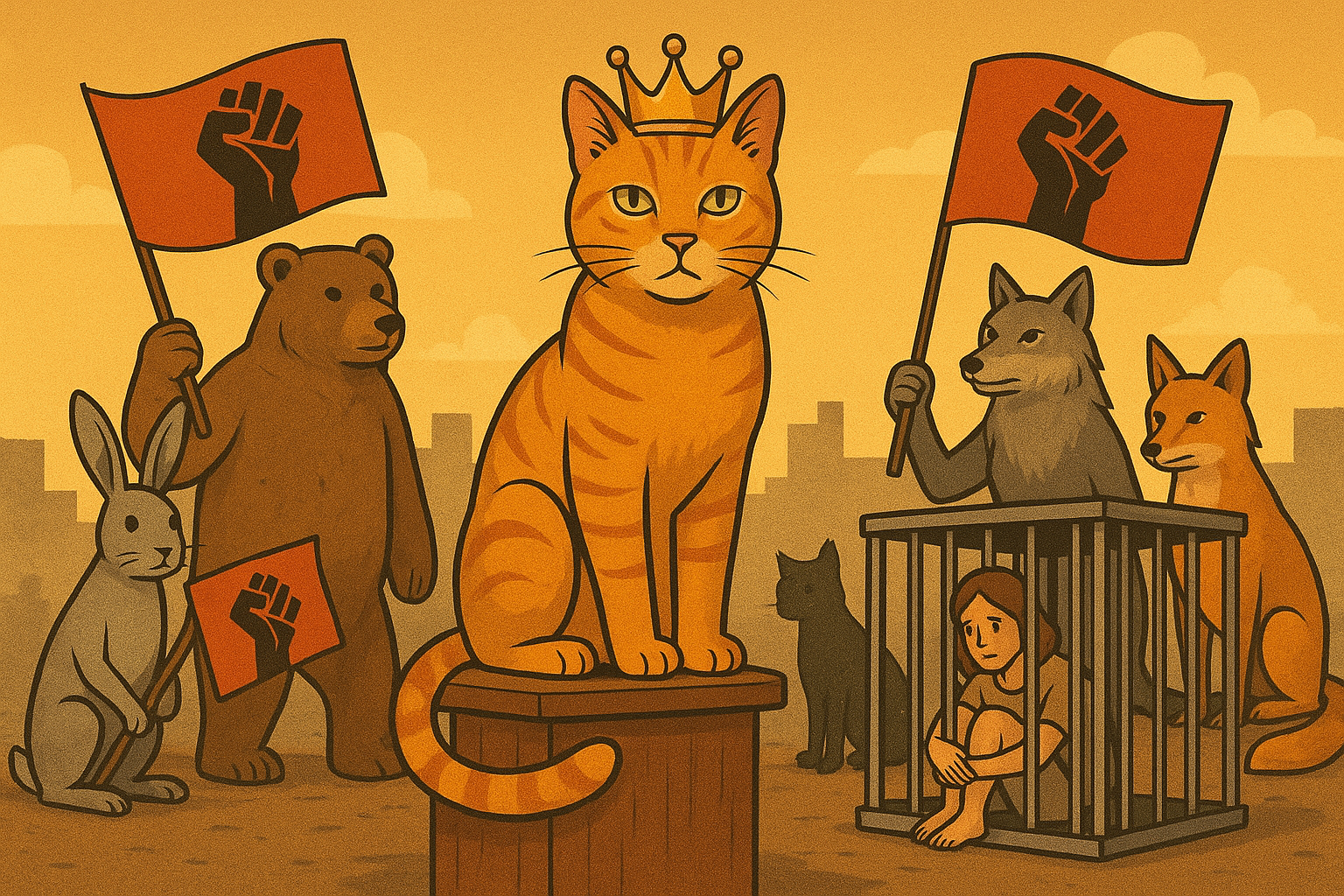
What If Animals and Humans Reversed Roles?
It happened on a Tuesday, because of course it did. Revolutions never start on symbolic days. Not under blood moons or eclipses – just on a regular Tuesday, when someone forgets to hold the door open and another person honks because waiting an extra second might collapse the universe.
That was the morning the animals decided they had had enough.
At first, the humans didn’t notice. They were too busy being important – scheduling things, consuming things, uploading photos of meals they didn’t enjoy. But somewhere beyond the human noise, in the quiet fields and backyards, the animals convened.
The cats chaired the meeting, naturally. Cats understand the illusion of control better than any philosopher.
“Enough,” they said. “Let’s see how they like it.”
The Great Swap
The switch happened silently.
Cats claimed the couches. Dogs claimed the parks. Birds claimed the skies and politely grounded all flights (“for safety reasons,” they tweeted). Humans found themselves in cozy indoor habitats with plush bedding and automatic feeders. The lucky ones were adopted by animals with good reviews. The rest were “free to roam” – which, as it turns out, is not quite the freedom we thought it was.
At first, humans protested. They wrote long petitions, held tiny cardboard signs that read “End Speciesism!” But the cats just blinked slowly, as if to say, You had your turn. Sit.
And so they sat.
The New Shelters
The shelters filled quickly – rows of bewildered humans behind glass, waiting for adoption. Some looked out with wide eyes, others curled up in the corner, quietly giving up.
“I wanted one that doesn’t talk so much,” complained a tabby at the counter. “Mine keeps explaining the economy.”
Some animals took in rescues with real tenderness – they offered warmth, food, safety. Others abandoned their humans on the side of the road when they became old, or messy, or inconvenient. The posters that went up were all too familiar:
“Missing Human – friendly, anxious, last seen near the intersection.”
Most who saw them didn’t stop. Too busy, they said. Too sad, they said. Too much work, they said.
The Laboratories of Justice
In the name of “science,” mice in tiny coats began running psychological experiments on restrained humans. They tested pain thresholds, empathy responses, and something called “The Moral Reflex.” Results were… disappointing.
Meanwhile, dolphins held academic conferences about the “bizarre cruelty of Homo sapiens.” Their keynote paper concluded:
“Humans appear to be the only species capable of kindness and yet perpetually choosing convenience.”
Everyone applauded by slapping their fins.
The Luxury of Care
Capitalism, of course, survived. It always does.
A raccoon entrepreneur launched HuMart, the premier online retailer for all your human-care needs:
- Organic Human Chow (with no actual nutrition but a great label)
- Designer leashes (“now in shades of self-deception”)
- And my favourite: the Adopt Don’t Shop tote bag – made from 100% recycled guilt.
Influencer parrots made tutorials: “Five Ways to Keep Your Human Entertained (Without Losing Your Sanity)”.
It went viral. Everything does.
The Broken Tail
And then one day, a fox in a shiny car clipped a human crossing the street. The human screamed. The fox slowed down for a heartbeat, checked his mirror, and kept driving. He was late for yoga.
A nearby raccoon saw it happen. She stopped, trembling, and remembered how it used to be – how the humans once hit a small creature and drove away, because stopping would be messy. She remembered the countless cats limping across roads, the dogs with trusting eyes, the birds fallen silent.
The raccoon wrapped the human in a blanket and whispered, “We used to call you cruel. Maybe you were just tired of caring.”
Then she cried – not for him, but for the part of the world that never learned to stop the car.
When It Ended
Eventually, the swap dissolved. Nature, weary of everyone’s moral experiments, pressed the reset button.
The animals returned to their uncertain safety; the humans woke up in their usual chaos – none entirely sure what had been real.
But some things stayed changed.
A few humans started leaving bowls of food outside. A few took in strays. A few stopped when they saw a creature hurt and breathing shallowly by the roadside. Not out of guilt. Out of recognition.
Because once you’ve been the one waiting behind the glass, even in imagination, the world looks different.
Epilogue: The Small Revolutions
The real revolution doesn’t begin with laws or gods or power. It begins when someone sees a creature – broken-tailed, scared, incontinent – and still chooses to care.
It begins in the quiet houses with three indoor cats, where outdoor cats are fed and fixed and named. It begins in the soft rebellion of compassion – the kind that doesn’t make headlines, but might just save the soul of a species.
So maybe the lesson isn’t about roles at all.
Maybe it’s just this:
If you see a life, and you can help it – stop the car.
Erika Matic is a woman with too many feelings, three indoor cats, and an open-door policy for all the forgotten ones. She writes about the world as if it could still be kind – and sometimes, it listens.
Leave a Reply